Pioneer VSX-1020 Manual: A Comprehensive Guide
This guide offers detailed instructions for the Pioneer VSX-1020 receiver, covering setup, operation, troubleshooting, and maintenance.
Explore features like Dolby and DTS decoding, alongside the Auto MCACC calibration system for optimal audio performance.
The Pioneer VSX-1020 is a 7.2-channel network AV receiver designed to deliver a high-quality home theater experience. Released as part of Pioneer’s mid-range lineup, it balances performance with affordability, making it a popular choice for enthusiasts seeking immersive sound. This receiver supports the latest audio and video technologies, including 4K Ultra HD pass-through and a range of surround sound formats like Dolby TrueHD and DTS-HD Master Audio.
This manual aims to provide a comprehensive understanding of the VSX-1020, from initial setup and connection of various audio and video sources, to advanced configuration options and troubleshooting common issues. Whether you’re a first-time AV receiver owner or an experienced audiophile, this guide will help you unlock the full potential of your Pioneer VSX-1020 and create a captivating home entertainment system. It will also cover network connectivity and streaming capabilities.
Understanding the VSX-1020’s Key Features
The Pioneer VSX-1020 boasts several key features enhancing the home theater experience. Notably, its 7.2-channel configuration allows for a truly immersive surround sound setup. It supports 4K Ultra HD pass-through with HDR, ensuring compatibility with modern displays and content. The receiver incorporates Dolby TrueHD and DTS-HD Master Audio decoding for high-fidelity audio reproduction.
A standout feature is the Auto MCACC (Multi-Channel Acoustic Calibration) system, which automatically optimizes speaker settings based on your room’s acoustics. Network connectivity via Ethernet and Wi-Fi enables streaming services and control via Pioneer’s iControlAV5 app. Furthermore, it includes Bluetooth for wireless audio streaming from mobile devices. Zone 2 audio output allows for independent audio playback in a second room, expanding your entertainment options. The VSX-1020 also features advanced connectivity options for various sources.

Setting Up Your Pioneer VSX-1020
Proper setup is crucial for optimal performance. This section details connecting speakers, audio/video sources, and establishing network connectivity for streaming capabilities.
Initial Connection and Speaker Setup
Begin by connecting the power cord securely to the VSX-1020 and a grounded outlet. Next, connect your speakers using appropriate speaker wire, ensuring correct polarity (+ to + and ― to -) for each channel. The receiver supports various speaker configurations, including 5.1, 7.1, and potentially more, depending on your setup.
Carefully match the speaker terminals on the receiver to the corresponding terminals on your speakers. Double-check all connections before proceeding. For optimal sound quality, use high-quality speaker wire of the appropriate gauge. Pay attention to impedance matching; the VSX-1020 is designed to work with specific impedance ranges. Incorrect impedance can damage the receiver or speakers.
Once the speakers are connected, power on the receiver and verify that all speakers are receiving a signal. The on-screen display (OSD) will guide you through the initial speaker setup process, allowing you to specify the speaker configuration and distances. Accurate speaker distance settings are vital for proper surround sound calibration.

Connecting Audio Sources (CD, DVD, Turntable)
The Pioneer VSX-1020 offers a variety of audio inputs to connect your favorite sources. For CD and DVD players, utilize the RCA audio inputs, selecting the corresponding input on the receiver. Optical (Toslink) and coaxial digital audio inputs are also available for higher-quality audio transmission. Ensure the source device’s audio output settings are configured correctly for the chosen connection type.
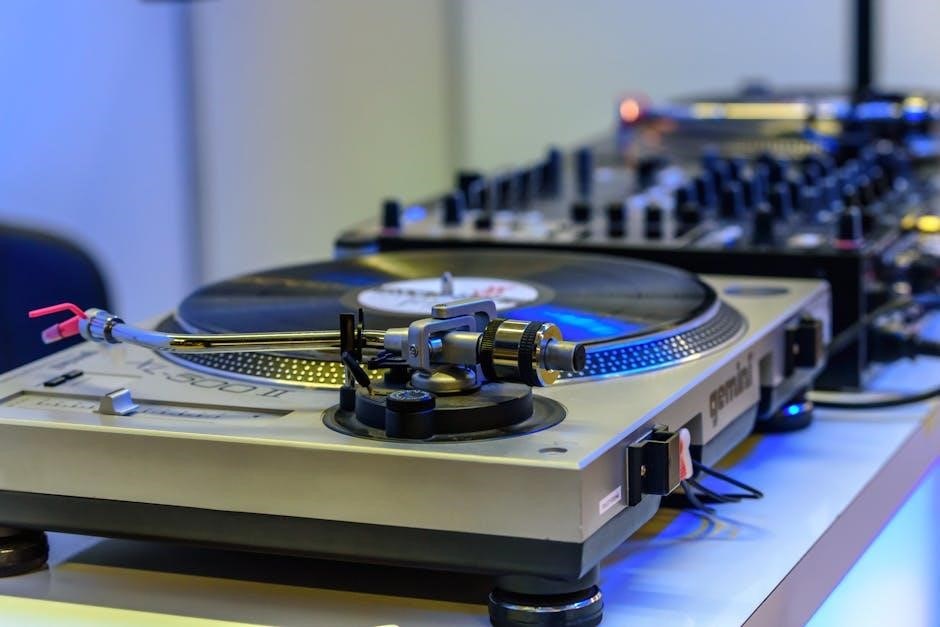
Connecting a turntable requires special consideration. If your turntable lacks a built-in phono preamp, you’ll need to connect it to a phono input on the receiver, or use an external phono preamp. The VSX-1020 may or may not have a dedicated phono input; consult the rear panel diagram.
Always power off both the receiver and the audio source before making or changing connections. After connecting, select the appropriate input on the receiver to enjoy audio from your chosen source. Verify the sound quality and adjust volume levels as needed.
Connecting Video Sources (TV, Projector)
The Pioneer VSX-1020 facilitates seamless video integration with your display devices. Utilize the HDMI outputs to connect to your TV or projector for both video and audio transmission, supporting high-resolution signals. Ensure you use high-speed HDMI cables for optimal performance, especially with 4K content. The receiver supports HDMI pass-through, allowing video signals to be routed even when the receiver is in standby mode.
For older devices lacking HDMI, composite and component video inputs are available, though these offer lower video quality. Select the corresponding video input on the receiver to match the connection type. Remember to configure the video output resolution settings on both the receiver and the display device for compatibility.
Always power down all devices before connecting or disconnecting cables. Verify the video signal is displayed correctly and adjust picture settings on your TV or projector as desired.
Network Connectivity and Streaming Setup
The Pioneer VSX-1020 offers robust network connectivity, enabling access to streaming services and internet radio. Connect the receiver to your home network via Ethernet cable for a stable connection, or utilize the built-in Wi-Fi for wireless convenience. Access the network settings through the on-screen display (OSD) and follow the prompts to enter your network credentials.
Once connected, explore the receiver’s streaming capabilities, including support for services like Spotify, Pandora, and vTuner internet radio. The VSX-1020 supports DLNA, allowing you to stream music files from networked devices. Ensure your network firewall allows access for the receiver to connect to these services.
Regularly check for firmware updates via the network connection to ensure optimal performance and access to the latest features.

Operating the Pioneer VSX-1020
Mastering the VSX-1020 involves understanding its controls, navigating the OSD, selecting inputs, and adjusting audio settings for a personalized listening experience.
Powering On/Off and Basic Controls
Initiating operation is simple: locate the power button, typically on the front panel, and press it to activate the VSX-1020. A standby indicator light will illuminate when the unit is in standby mode. To completely power off, press the power button again.
Essential controls include the volume knob for adjusting sound levels, and input selection buttons to choose your desired audio source – such as CD, DVD, or network streaming. The remote control duplicates these functions, offering convenient operation from a distance.
Additional buttons manage sound modes (like Dolby or DTS), and access the on-screen display (OSD) for advanced settings. Familiarize yourself with the layout of these controls for seamless operation. Remember to consult the manual for specific button functions and customization options.
Navigating the On-Screen Display (OSD)
The VSX-1020’s On-Screen Display (OSD) provides a user-friendly interface for configuring settings. Access it via the “Setup” button on the remote control. The OSD is navigated using the directional arrows on the remote – up, down, left, and right – to highlight different menu options.
Key sections within the OSD include Audio settings (for adjusting speaker levels and decoding formats), Video settings (for picture adjustments), Network settings (for connecting to your home network), and System settings (for general configurations).
Use the “Enter” button to select a highlighted option and the “Back” button to return to the previous menu. The OSD allows for precise customization of your audio and video experience. Refer to the manual for detailed explanations of each setting within the OSD.
Understanding Input Selection
The Pioneer VSX-1020 features multiple input options to accommodate various audio and video sources. Input selection is crucial for directing the correct signal to your receiver. Use the “Input” button on the remote control to cycle through available inputs – such as HDMI 1-6, Optical 1-2, Coaxial, Phono, and USB.
Each input corresponds to a specific device connected to the receiver. For example, HDMI 1 might be assigned to your Blu-ray player, while Optical 1 could be connected to your TV. The currently selected input is displayed on the front panel and the On-Screen Display (OSD).
Proper input selection ensures you’re receiving audio and video from the desired source. You can also rename inputs within the OSD for easier identification. Refer to the connection guide to confirm which input is assigned to each device.
Adjusting Volume and Tone Controls
The Pioneer VSX-1020 provides comprehensive control over your listening experience through volume and tone adjustments. The primary volume control is accessible via the front panel knob and the remote control. Fine-tune the volume to achieve your desired listening level, being mindful of potential distortion at excessively high volumes.
Tone controls allow you to customize the audio frequencies. The VSX-1020 typically includes bass and treble adjustments. Increasing bass enhances low-frequency sounds, while boosting treble emphasizes high-frequency sounds. Experiment with these settings to tailor the sound to your preferences and the specific audio source.
Additional sound modes, accessible through the OSD, offer preset equalization curves for various content types like music, movies, and games. Explore these modes to find the optimal sound profile for your enjoyment.

Advanced Features and Settings
Unlock the VSX-1020’s full potential with advanced settings like audio decoding, Auto MCACC calibration, surround sound configuration, and Zone 2 audio setup for multi-room listening.
Decoding Audio Formats (Dolby, DTS)
The Pioneer VSX-1020 excels in audio decoding, supporting a wide range of formats for an immersive listening experience. It natively decodes Dolby Digital, Dolby Digital Plus, and DTS, bringing cinematic sound to your home theater. These technologies utilize multi-channel audio to create a realistic soundscape, positioning sounds accurately within your listening space.
To ensure proper decoding, verify your source device is outputting a compatible format. The receiver automatically detects the incoming audio signal and selects the appropriate decoding mode. You can also manually select the decoding mode within the receiver’s settings menu, allowing for customization based on your preferences and source material.
Furthermore, the VSX-1020 supports high-resolution audio formats, enhancing clarity and detail. Experiment with different decoding options to find the optimal setting for each source, maximizing the audio quality and enjoying a truly captivating sound experience. Proper decoding is crucial for experiencing the full dynamic range and immersive qualities of modern audio content.

Utilizing the Auto MCACC Calibration System
Pioneer’s exclusive Multi-Channel Acoustic Calibration System (MCACC) is a powerful tool for optimizing the VSX-1020’s sound output to your specific room acoustics. This automated system analyzes your speaker configuration, distance from listening position, and room characteristics to deliver balanced and accurate sound.
To initiate MCACC, connect the included microphone to the receiver and place it at your primary listening position. Follow the on-screen prompts to begin the calibration process. The system will emit test tones through each speaker, measuring its response and adjusting parameters like speaker level, equalization, and time alignment.
MCACC creates a customized sound profile tailored to your room, minimizing reflections and standing waves. After calibration, listen to various sources to verify the improved sound quality. You can further refine the MCACC settings manually if desired, allowing for personalized adjustments to achieve your ideal listening experience.
Configuring Surround Sound Settings
The Pioneer VSX-1020 offers a variety of surround sound configurations to enhance your home theater experience. Access these settings through the on-screen display (OSD) under the “Surround” menu. You can select pre-programmed sound modes like Dolby Surround, DTS Neural:X, and various listening modes optimized for movies, music, and games.
Customize your surround experience by adjusting parameters like speaker size (small or large), crossover frequency, and distance settings. Ensure these settings accurately reflect your speaker setup for optimal performance. Experiment with different surround modes to find the one that best suits your content and personal preferences.
For advanced users, the VSX-1020 allows manual configuration of individual speaker levels and equalization. This provides precise control over the soundstage, allowing you to fine-tune the surround sound to your exact specifications. Remember to save your preferred settings for future use.
Setting Up Zone 2 Audio
The Pioneer VSX-1020 allows you to enjoy audio in a second room, known as Zone 2. To activate Zone 2, navigate to the “Zone” menu within the on-screen display (OSD). First, ensure you have speakers connected to the Zone 2 speaker terminals on the receiver’s rear panel;
Select the desired audio source for Zone 2 – this can be a different input than the main zone, allowing independent listening. You can choose to synchronize the audio between Zone 1 and Zone 2, or play different content in each zone simultaneously. Adjust the volume for Zone 2 independently using the remote control.
Consider the limitations of Zone 2; it typically operates in stereo mode. Explore the settings to optimize the audio output for the connected speakers and ensure a balanced listening experience in both zones. Save your Zone 2 configuration for convenient access.

Troubleshooting Common Issues
This section addresses frequent problems with the VSX-1020, including sound loss, remote malfunctions, network connectivity, and display errors. Find solutions for a seamless experience.
No Sound Output
Experiencing a lack of sound from your Pioneer VSX-1020? Several factors could be at play. First, verify the volume level on both the receiver and the connected source device. Ensure the receiver isn’t muted! Check speaker connections – are they securely attached to both the receiver and the speakers themselves? A loose connection is a common culprit.
Confirm the correct input source is selected on the VSX-1020. Accidentally choosing the wrong input will naturally result in no audio. Test with different audio sources (CD, DVD, streaming) to isolate whether the issue is source-specific or receiver-wide. Inspect speaker wires for any damage or fraying.
If using surround sound, ensure the speaker configuration in the receiver’s settings matches your actual speaker setup. Consider resetting the receiver to its factory defaults as a last resort; this can resolve software glitches. Finally, consult the manual’s troubleshooting section for specific error codes or further guidance.
Remote Control Not Working
Is your Pioneer VSX-1020 remote control unresponsive? Begin with the simplest solution: replace the batteries with fresh ones, ensuring correct polarity. Check for obstructions between the remote and the receiver’s infrared (IR) sensor – even a small object can block the signal. Clean the IR sensor on the receiver with a soft, dry cloth to remove any dust or grime.
Try resetting the remote by removing and reinserting the batteries. Ensure you’re pointing the remote directly at the receiver’s IR sensor. Test the remote’s functionality using a camera or smartphone; you should see a faint flashing light when a button is pressed.
If the remote still fails, consider re-pairing it with the receiver (refer to the manual for specific pairing instructions). A faulty remote may require replacement. Check the Pioneer website for compatible replacement remotes or contact customer support for assistance.
Network Connection Problems
Experiencing network connectivity issues with your Pioneer VSX-1020? First, verify your home network is functioning correctly by testing other devices. Ensure the receiver is within range of your Wi-Fi router and that the signal strength is adequate. Double-check the Wi-Fi password entered into the receiver’s settings – even a single incorrect character can prevent connection.
Restart both your router and the VSX-1020. This often resolves temporary network glitches. Confirm the receiver’s IP address is correctly assigned, either automatically via DHCP or manually configured. Check for firmware updates for the receiver; outdated firmware can sometimes cause connectivity problems.
If using a wired connection, ensure the Ethernet cable is securely connected to both the receiver and the router. Consider disabling any firewall settings that might be blocking the receiver’s access. Consult the Pioneer support website for further troubleshooting steps.
Display Issues and Error Messages
Encountering display problems or error messages on your Pioneer VSX-1020? Begin by checking the cable connection between the receiver and your TV or projector – ensure it’s firmly seated. Verify the correct input is selected on both the receiver and the display device. Adjust the display settings within the receiver’s on-screen menu to optimize brightness and contrast.
If the display is completely blank, try power cycling both the receiver and the display. Note any specific error codes displayed, as these provide valuable clues for diagnosis. Consult the receiver’s manual for a list of error codes and their corresponding solutions.
For distorted or flickering images, experiment with different HDMI cables. A factory reset of the receiver may resolve persistent display issues, but remember this will erase custom settings. Contact Pioneer support if problems persist, providing the error code and a detailed description of the issue.

Maintenance and Care
Regular cleaning, firmware updates, and speaker wire checks will ensure the longevity of your Pioneer VSX-1020. Proper storage protects against damage when not in use.

Cleaning the Unit
Maintaining the exterior of your Pioneer VSX-1020 is crucial for its appearance and longevity. Always disconnect the power cord from the electrical outlet before commencing any cleaning procedures. Use a soft, dry cloth to gently wipe down the front panel, top surface, and sides of the receiver. Avoid using harsh chemicals, abrasive cleaners, or solvents, as these can damage the finish.
For stubborn dust or fingerprints, lightly dampen the cloth with a mild detergent solution – ensure the cloth is only slightly damp, not wet. Never spray liquid directly onto the unit. Pay particular attention to the ventilation slots on the rear panel; use a small brush or compressed air to remove any accumulated dust, ensuring proper airflow.
The remote control can be cleaned using a similar method – a soft, dry cloth is generally sufficient. Avoid excessive moisture. Regular cleaning prevents dust buildup, which can contribute to overheating and potential malfunctions, keeping your VSX-1020 looking and performing its best.
Firmware Updates
Keeping your Pioneer VSX-1020’s firmware up-to-date is essential for optimal performance and access to the latest features; Pioneer periodically releases firmware updates to improve compatibility, fix bugs, and enhance functionality. Check the official Pioneer website regularly for available updates specifically for the VSX-1020 model.
Typically, firmware updates are delivered as a downloadable file that can be transferred to a USB flash drive. Consult the Pioneer website for detailed instructions on the update process, as incorrect installation can potentially damage the receiver. Ensure the USB drive is formatted correctly (usually FAT32) and that the receiver has a stable power supply during the update.
Do not interrupt the update process under any circumstances. Following the on-screen prompts carefully is crucial. Successful updates can improve audio and video quality, add support for new formats, and resolve any known issues, extending the life and usability of your VSX-1020.
Speaker Wire Inspection
Regularly inspecting your speaker wires is a crucial aspect of maintaining optimal audio quality with your Pioneer VSX-1020. Over time, speaker wires can become frayed, corroded, or loose, leading to signal degradation and potential sound issues. Visually examine each wire for any signs of damage, paying close attention to the connections at both the receiver and the speakers.
Ensure all connections are secure and tight. Loose connections can cause intermittent sound or complete signal loss. If corrosion is present, carefully clean the terminals with a contact cleaner specifically designed for electronics. Replace any wires that are significantly damaged or corroded to guarantee a clean and reliable audio signal.
Properly routed and secured speaker wires also prevent accidental disconnections and potential short circuits. A proactive approach to speaker wire maintenance will ensure consistent, high-fidelity sound from your VSX-1020 for years to come.
Long-Term Storage Guidelines
If you plan to store your Pioneer VSX-1020 for an extended period, proper preparation is essential to prevent damage and ensure its continued functionality. Begin by disconnecting all cables – power, audio, and video – and storing them separately in a dry, safe location. Clean the receiver thoroughly with a soft, dry cloth to remove dust and debris.
Ideally, store the VSX-1020 in its original packaging to provide maximum protection against physical impacts and environmental factors. If the original packaging isn’t available, use a sturdy box with ample padding. Choose a cool, dry storage environment, avoiding areas with high humidity or extreme temperatures.
Periodically check the stored unit (every few months) to ensure no moisture has accumulated. Consider using a desiccant pack inside the box to absorb any potential humidity. Following these guidelines will help preserve your Pioneer VSX-1020’s condition during long-term storage.